Construction Machinery OEM vs ODM: Key Differences That Affect Quality
In heavy equipment sourcing, the gap between OEM and ODM is not a branding detail. It shapes design authority, process control, spare parts consistency, and field performance.
That matters even more in land transport equipment, where construction machinery often works beside heavy trucks, trailers, and logistics fleets in demanding operating cycles.
A clear view of construction machinery OEM and ODM models helps quality evaluation move beyond brochures. It also makes supplier comparison more accurate and more practical.
Why the distinction matters now
Global demand for infrastructure, mining support, municipal projects, and industrial transport keeps expanding. Equipment buyers are under pressure to secure reliable capacity without adding hidden lifecycle risk.
At the same time, digital B2B channels make supplier discovery easier. The challenge is no longer finding options. The real task is identifying which production model supports stable quality.
On platforms covering trucks, chassis, trailers, construction machinery, and spare parts, many products may look comparable at first glance. Their manufacturing logic is often very different.
This is where construction machinery OEM analysis becomes useful. It reveals who controls drawings, who validates components, and who remains responsible after delivery.
OEM and ODM in practical terms
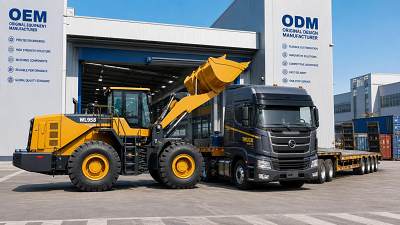
OEM usually means the buyer or brand owner defines the product. The factory manufactures according to approved specifications, tolerances, materials, and testing requirements.
ODM usually means the factory owns or largely controls the base design. The buyer selects, adjusts, or rebrands an existing solution with limited engineering changes.
In construction machinery, the difference affects more than structure. It can influence hydraulics, engine integration, cab layout, electronic architecture, frame fatigue life, and serviceability.
A construction machinery OEM arrangement often provides stronger traceability. An ODM arrangement may shorten development time, but design transparency can be narrower.
A simple comparison
Where quality differences actually appear
The most important quality issues are rarely visible in sales photos. They usually appear in repeatability, component compatibility, and durability under variable loads.
For example, two wheel loaders may share similar dimensions. Yet weld quality, hydraulic hose routing, pin bushing hardness, and electrical sealing may differ sharply.
In a construction machinery OEM project, those details are more likely to be frozen through controlled drawings, inspection plans, and approved suppliers.
With ODM, quality can still be strong. But confidence depends on how mature the base platform is and how openly the supplier shares validation data.
Key quality points to review
- Structural durability, including frame stress concentration and weld consistency.
- Powertrain and hydraulic matching across load ranges and climate conditions.
- Electrical reliability, especially connectors, harness protection, and sensor calibration.
- Parts interchangeability across production batches.
- Field maintenance access and spare parts documentation.
How this connects to land transport equipment
Construction machinery does not operate in isolation. It often supports truck loading, road building, site preparation, cargo movement, and municipal transport projects.
Because of that, equipment quality affects the wider transport chain. A weak machine can delay truck utilization, increase idle time, and disrupt project scheduling.
This is one reason the construction machinery OEM model attracts attention across global heavy truck ecosystems. Integration reliability matters across machines, vehicles, and parts supply.
On a specialized industry platform, cross-category visibility becomes useful. Supplier evaluation can include machinery, trailers, truck components, and aftermarket capability in one review path.
When OEM tends to be the better fit
OEM is often preferred when the application is demanding, the operating environment is harsh, or fleet standardization is already established.
That includes equipment used in mining logistics, long-duty municipal cycles, infrastructure contractors, and projects requiring parts compatibility with existing service systems.
A construction machinery OEM program is also useful when certification, detailed documentation, or engineering change approval must be controlled from the buyer side.
In these cases, the value is not only product quality. It is also the ability to preserve quality over time and across multiple production runs.
When ODM can still make sense
ODM is not automatically a lower-quality route. In some categories, it is the fastest way to access a mature platform with acceptable cost and lead time.
It can work well for less complex configurations, pilot market entry, or projects where the base design has already proven stable in similar duty conditions.
The key is to verify whether the ODM supplier manages version control, supplier qualification, testing records, and service parts continuity with the same discipline as an OEM program.
If that evidence is weak, lower initial cost may lead to inconsistent assemblies, difficult warranty discussions, or uneven spare parts availability.
What to ask during supplier evaluation
Good evaluation starts with documents, but it should not stop there. The goal is to connect paperwork with manufacturing behavior.
- Who owns the core drawings, software logic, and bill of materials?
- Which components are fixed, and which may change without prior approval?
- How are welding, machining, painting, and final inspection controlled?
- Can the factory provide fatigue tests, bench tests, and field validation records?
- How is after-sales support organized across export markets?
- Are spare parts coded consistently across batches and model updates?
These questions help distinguish a true construction machinery OEM capability from a trading presentation built on limited technical depth.
Signals that deserve closer attention
Using digital sourcing channels more effectively
A specialized global platform can shorten the screening cycle when it combines product access with supplier data, category coverage, and industry reference information.
That is especially helpful when comparing construction machinery suppliers alongside truck brands, chassis systems, trailers, and spare parts resources.
The practical advantage is context. A supplier should not be judged only by catalog appearance, but by fit within broader transport, construction, and support requirements.
For construction machinery OEM sourcing, digital tools become most valuable when they support side-by-side comparison, verification of capabilities, and informed follow-up questions.
A useful way to move forward
The real choice between OEM and ODM is not about labels. It is about how much technical control, transparency, and lifecycle stability the project requires.
If operating conditions are severe or fleet compatibility matters, a construction machinery OEM route often justifies deeper technical review and tighter documentation demands.
If the target is faster deployment with a proven standard platform, ODM can remain viable, provided process discipline and service continuity are verified carefully.
A practical next step is to map required performance, expected duty cycle, parts strategy, and change-control needs before comparing suppliers. That framework usually makes the better model clear.
Trending News
- How to compare concrete mixer truck suppliers by total landed cost
- How axle load limits affect low bed trailer exports to Southeast Asia
- How to locate a truck exhaust system leak before replacing parts
- When does heavy equipment transport require a lowboy trailer?
- When does a light commercial vehicle for urban delivery save fleet costs?
Tag
Recommended News
 Technology & InnovationConstruction Machinery OEM: Key Specs That Affect Integration QualityConstruction machinery OEM selection starts with specs. Learn how dimensions, hydraulics, electrical interfaces, and documentation shape integration quality, safety, and uptime.
 Technology & InnovationHow Truck Body Design Affects Payload and Fuel EfficiencyTruck body design directly affects payload, fuel efficiency, and operating cost. Learn how the right truck body boosts performance, reduces waste, and improves fleet value.
 Technology & InnovationHydraulic Pump Selection Mistakes That Lead to DowntimeHydraulic pump selection mistakes can quietly trigger costly downtime in transport equipment. Learn what to verify before buying and choose with more confidence.
 Technology & InnovationManzhouli Smart Sealing Cuts TIR-Rail Clearance to 3.2 HoursManzhouli Smart Sealing cuts TIR-rail clearance to 3.2 hours, boosting visibility and delivery certainty for China-Europe cargo. See what it means for exporters and forwarders.
 Technology & InnovationConstruction Machinery OEM vs ODM: Key Differences That Affect QualityConstruction machinery OEM vs ODM explained: discover how design control, parts consistency, and lifecycle quality affect performance, sourcing risk, and smarter buying decisions.
 Technology & InnovationBULLDOZER with GPS Tracking: Benefits for Jobsite ControlBULLDOZER with GPS tracking improves jobsite control with better grading accuracy, fleet coordination, and uptime. See how it reduces rework and boosts project efficiency.
 Technology & InnovationGlobal Heavy-Duty Autonomous Trucks Near CommercializationHeavy-duty autonomous trucks are nearing commercialization — 200+ L4 vehicles deployed in Saudi & Chilean mines, delivering 120,000+ km fault-free haulage.
 Technology & InnovationWhen to Use an Excavator With Long Reach Boom on SiteEXCAVATOR with long reach boom guide: learn when it adds real value for dredging, demolition, slopes, and drainage jobs to improve safety, access, and site efficiency.
 Technology & InnovationGlobal Heavy-Duty Autonomous Truck Testing Reaches Commercial Inflection PointHeavy-duty autonomous truck testing hits commercial inflection point: 1M km L4 mining ops in Saudi Arabia & Chile — key for OEMs, mining logistics & global off-road transport.
 Technology & InnovationWhat Advanced Technology Means in Heavy Truck Chassis DesignDiscover how a heavy truck chassis manufacturer with advanced technology improves strength, durability, payload efficiency, and integration for demanding transport needs.
 Technology & InnovationChina Adds Tractor-Trailers' Battery-Swap Systems to NEV Bus Subsidy SchemeBattery-swap systems for tractor-trailers now qualify for China’s NEV bus subsidy—up to ¥32,000 per system. Key for logistics, mining & port electrification.
 Technology & InnovationPortable Construction Machinery Supplier: Where Mobility Improves Jobsite OutputConstruction machinery supplier with portable options helps contractors cut mobilization time, improve transport efficiency, and boost jobsite output across road, municipal, and multi-site projects.
 Technology & InnovationChina Adds Heavy-Duty Tractor Battery-Swap Systems to EV Bus Subsidy SchemeHeavy-duty tractor battery-swap systems now qualify for China’s 2026 EV bus subsidy—30% off, up to ¥280,000. Act before Dec 31!
 Technology & InnovationDo Energy-Saving Excavators Lower Fuel Use in Daily Jobsite Operations?Excavator manufacturer with energy-saving features: discover how smarter hydraulics, auto idle, and telematics can cut daily fuel use, improve uptime, and lower jobsite operating costs.
 Technology & InnovationL4 Autonomous Trucks Launch on Tianjin Port–Xiong’an RouteL4 autonomous trucks launch on Tianjin Port–Xiong’an route—first routine platooned operations in China’s strategic logistics corridor. Watch EU & Gulf certification unfold.
 Technology & InnovationAre Energy-Saving Excavators Worth It for Long-Term Operations?Excavator manufacturer with energy-saving features: discover if lower fuel use, reduced downtime, and stronger long-term ROI make these machines the smart choice for demanding operations.
 Technology & InnovationSouth China Pioneer Studio Wins Youth May 4th Award for Smart Truck CertificationSmart truck certification breakthrough: South China Pioneer Studio wins Youth May 4th Award for EU R155/R156 compliance — a game-changer for global陆路运输设备 exports.
 Technology & InnovationL4 Autonomous Container Trucks Begin Trial on Tianjin Port–Xiong'an CorridorL4 autonomous container trucks begin trial on Tianjin Port–Xiong'an Corridor—key milestone for cross-border logistics, heavy-equipment transport & smart intermodal supply chains.
 Technology & InnovationQuick Installation Excavators: Do They Reduce Setup Time on Real Sites?Excavator manufacturer with quick installation: discover whether fast-deploy excavators truly cut real-site setup time, lower labor costs, and improve uptime before you buy.
 Technology & InnovationModular Flatbed Trailers: When Design Flexibility Improves UtilizationFind out how a flatbed trailer supplier with modular design helps fleets boost utilization, adapt to varied loads, cut idle assets, and improve long-term ROI.
 Technology & InnovationPortable Construction Machinery: Where Flexible Equipment Saves TimeConstruction machinery supplier with portable options helps cut relocation time, improve transport efficiency, and keep projects moving faster across changing job sites.
 Technology & InnovationSemi Trailer Manufacturer with Lightweight Design: Is Lower Weight Worth It?Semi trailer manufacturer with lightweight design: discover when lower weight boosts payload, fuel savings, and fleet ROI—and when durability, compliance, and repair costs matter more.
![]() Technology & InnovationWhy Quick Installation Matters When Choosing an Excavator ManufacturerExcavator manufacturer with quick installation: discover how faster setup cuts downtime, simplifies maintenance, improves reliability, and keeps heavy equipment projects on schedule.
Technology & InnovationWhy Quick Installation Matters When Choosing an Excavator ManufacturerExcavator manufacturer with quick installation: discover how faster setup cuts downtime, simplifies maintenance, improves reliability, and keeps heavy equipment projects on schedule. Technology & InnovationHow Modular Design Changes the Value of a Flatbed Trailer SupplierFlatbed trailer supplier with modular design: discover how modular platforms cut lifecycle costs, boost fleet flexibility, and improve ROI for logistics, construction, and industrial buyers.
 Technology & InnovationHow Portable Construction Machinery for Mining Helps Remote Projects Move FasterConstruction machinery for mining helps remote projects move faster with easier transport, quick setup, and flexible deployment. Learn how to cut delays and improve site efficiency.