How to Choose a Reliable Excavator Supplier in 2026
Choosing a reliable excavator supplier in 2026 is no longer a simple price comparison. Equipment buyers now face tighter delivery windows, uneven global quality, and higher pressure to keep projects moving without costly interruptions.
That matters across road transport equipment and heavy machinery markets, where excavators often work alongside trucks, trailers, and other construction assets. A dependable supplier supports not only procurement efficiency, but also fleet planning, service continuity, and long-term operating cost control.
Why supplier selection carries more weight in 2026
Demand for infrastructure, mining support, municipal works, and logistics-related construction remains active in many regions. At the same time, sourcing has become more global, which expands choice but also increases verification work.
A weak supplier relationship can create delays that go far beyond one machine. It may affect transport scheduling, operator deployment, parts stocking, and the utilization of supporting trucks on the same project.
This is why a reliable excavator supplier should be evaluated as a long-term business partner, not just a seller of units. The right decision improves uptime, cost predictability, and after-sales coordination.
What a reliable excavator supplier really means
Reliability is broader than product quality alone. A supplier may offer strong machine specifications, yet still create risk through poor documentation, unstable lead times, or limited service response.
In practical terms, a reliable excavator supplier usually combines verified manufacturing capability, consistent communication, transparent terms, and dependable support after delivery.
It also means the supplier understands real operating conditions. Excavators used in roadwork, quarry operations, or urban utility projects require different attachments, undercarriage choices, and maintenance planning.
Core signals of reliability
- Stable production capacity and clear delivery schedules.
- Traceable quality control and complete technical documents.
- Responsive spare parts support and realistic warranty terms.
- Experience in export procedures, compliance, and packaging.
- A track record in similar industries or project environments.
The first checks before comparing prices
Price still matters, but it should not be the first filter. Initial screening should focus on fit, legitimacy, and operating capability.
Start by confirming whether the supplier is a manufacturer, an authorized exporter, or a trading company with technical support resources. Each model can work, but the service structure must be clear.
Then look at product range and specialization. An excavator supplier that also works within broader heavy equipment and transport ecosystems may better understand site logistics, machine compatibility, and parts movement.
Quality is more than the machine itself
A quotation may highlight engine power, bucket capacity, or hydraulic performance. Those are important, but they do not tell the full story.
A capable excavator supplier should explain how the machine performs over time. That includes wear part availability, service intervals, oil system protection, and durability under local site conditions.
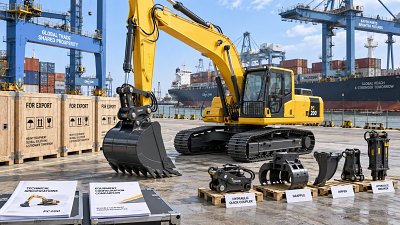
It is also useful to check whether the supplier can support attachment integration. Many projects need breakers, grapples, augers, or quick couplers, and weak integration often leads to hidden costs later.
Questions worth asking
- What components are sourced in-house and what comes from outside vendors?
- Which parts fail most often in similar operating environments?
- How quickly can common consumables and critical parts be shipped?
- What inspection records are available before loading?
Service support often determines the real value
An excavator is rarely judged only at delivery. Its value becomes clear during operation, especially when troubleshooting is needed under schedule pressure.
This is where many supplier comparisons change. A lower initial price can become expensive if parts are delayed, technical support is vague, or warranty responsibility is disputed.
A reliable excavator supplier should provide a clear service path. That may include digital manuals, video diagnostics, parts codes, maintenance guidance, and escalation contacts for urgent cases.
For cross-border sourcing, multilingual communication and export documentation are equally important. Delays caused by missing certificates or incorrect shipping papers can be as damaging as a mechanical issue.
How platform-based sourcing improves evaluation
Digital sourcing platforms have changed how heavy equipment is compared. Instead of relying on scattered contacts, buyers can review supplier portfolios, product categories, and market signals in one place.
Within the broader commercial vehicle and heavy equipment sector, this matters because excavators are rarely purchased in isolation. They are part of a connected operating chain that includes trucks, trailers, spare parts, and support equipment.
The Global Heavy Truck Industry Platform reflects this broader context. By connecting manufacturers, suppliers, distributors, and buyers across heavy trucks and construction machinery, it helps users compare an excavator supplier with better market visibility.
Access to directories, industry insights, and buying guides also supports better judgment. Instead of reviewing a machine in isolation, sourcing teams can assess supplier strength, category depth, and international trade readiness.
Typical sourcing scenarios and what changes in each one
Supplier evaluation should match the use case. The right partner for one procurement project may not be ideal for another.
Project-based acquisition
Short-cycle projects usually prioritize quick delivery, site-ready configuration, and immediate parts access. Here, an excavator supplier must prove speed and execution discipline.
Fleet expansion
For larger fleet planning, consistency becomes more important. Standardized models, repeat orders, and maintenance compatibility often outweigh a small difference in unit price.
Export or regional distribution
In this case, branding support, technical files, parts programs, and stable supply capacity matter more. The supplier should think beyond one shipment and support ongoing channel development.
Practical warning signs that should not be ignored
Some risks appear early if the review process is disciplined. Paying attention to them can prevent expensive corrections later.
- Specifications change between quotation, brochure, and proforma invoice.
- The supplier avoids factory verification or offers unclear ownership details.
- Warranty language is broad in sales talk but weak in written terms.
- Parts availability is promised without stock logic or delivery timing.
- Communication becomes slow once technical questions are raised.
A trustworthy excavator supplier may not always be the cheapest or the fastest to answer. What matters is consistency, evidence, and the ability to support the machine after it enters service.
Building a smarter shortlist
A practical shortlist usually comes from combining technical fit, supply reliability, and service readiness. That approach is more effective than filtering by price alone.
It helps to score each excavator supplier against the same criteria, then compare findings with the operating scenario in mind. Small differences in lead time, parts policy, or attachment support can shape total project cost.
The next step is straightforward: define the application, list non-negotiable technical and service requirements, and compare suppliers through verified information rather than assumptions. In 2026, better sourcing decisions come from better structure, not just broader choice.
Trending News
- How to compare concrete mixer truck suppliers by total landed cost
- How axle load limits affect low bed trailer exports to Southeast Asia
- How to locate a truck exhaust system leak before replacing parts
- When does heavy equipment transport require a lowboy trailer?
- When does a light commercial vehicle for urban delivery save fleet costs?
Tag
Recommended News
 Buying GuideHow to compare concrete mixer truck suppliers by total landed costCompare truck cement mixer supplier quotes by total landed cost, including freight, duties, and delivery. Uncover hidden charges and choose the best-value truck for your fleet.
 Buying GuideWhen does heavy equipment transport require a lowboy trailer?Does your heavy equipment need a lowboy trailer? Discover how loaded height, weight distribution, loading access, and route limits determine the right choice for safe transport.
 Buying GuideHow to choose an off road truck for steep and unstable job sitesChoose the right off road truck for steep, unstable job sites. Compare traction, braking, stability, clearance, payload, and route-test essentials.
 Buying GuideHow to match crane truck lifting capacity to your jobsite loadsCrane truck capacity planning made clear: calculate gross load, radius, rigging, outriggers, and ground conditions to select safer, job-ready lifting equipment.
 Buying GuideHow to match lowbed trailer deck height to your hauling equipmentLowbed trailer deck height guide: match equipment clearance, ramp geometry, axle loads, tractor fit, and route limits for safer, more efficient hauling.
 Buying GuideWhat to verify before choosing a delivery truck supplier for school transportationDelivery truck supplier for school transportation: verify route fit, payload, safety, compliance, service support, and total cost before choosing a reliable partner.
 Buying GuideWhat an excavator manufacturer catalog should show before you compare modelsExcavator manufacturer catalog guide: verify supplier identity, configurations, hydraulics, compliance, parts support, and delivery readiness before comparing models.
 Buying GuideWhat to check before appointing a bulldozer distributorBulldozer distributor selection guide: evaluate service, parts availability, warranty, pricing, compliance, and lifecycle value to reduce downtime and protect fleet investment.
 Buying GuideWhat to verify before choosing a truck cement mixer supplierTruck cement mixer supplier checklist: verify chassis fit, drum quality, hydraulics, compliance, spare parts, and after-sales support before you buy.
 Buying GuideHow to verify a truck spare parts supplier before placing a bulk orderTruck spare parts supplier verification made practical: learn how to check part specifications, factory control, test records, samples, pricing, and delivery capability before placing a bulk order.
 Buying GuideWhat size truck container is right for a typical freight load?Truck container sizing made simple: compare payload, volume, pallet layouts, route access, and loading needs to choose the most efficient freight solution.
 Buying GuideWhat drives semi trailer price differences between similar models?Semi trailer price differences come down to frame materials, axles, suspension, coating, and configuration. Compare specifications line by line to choose lasting value.
 Buying GuideHow to compare excavator manufacturer price lists before requesting quotesCompare an excavator manufacturer price list with confidence. Learn to normalize configurations, calculate landed costs, assess options and service, and create stronger RFQs.
 Buying GuideHow to choose a mixer truck drum capacity for your concrete pourMixer truck capacity guide: match drum size to pour rate, legal payload, site access, and delivery cycles for efficient, reliable concrete placement.
 Buying GuideHow to size a bulldozer for construction site grading workBulldozer for construction sizing guide: match weight, blade, traction, grade control, and transport needs to improve grading productivity and costs.
 Buying GuideHow to assess a truck cement manufacturer’s build quality before orderingTruck cement manufacturer build quality: assess tank steel, welding, chassis integration, pneumatic systems, factory QC, and inspection evidence before ordering.
 Buying GuideWhen does a truck trailer OEM make sense for private-label fleets?Truck trailer OEM programs help private-label fleets cut lifecycle costs, standardize operations, and improve uptime. Learn when customization delivers real commercial value.
 Buying GuideWhat to verify before choosing a water truck OEM for your fleetWater truck OEM selection guide: verify chassis compatibility, tank quality, pump performance, compliance, and service support to build a safer, more reliable fleet.
 Buying GuideHow to size a cab chassis truck for a fire department apparatusCab chassis truck for fire department sizing guide: balance GVWR, axle loads, wheelbase, water tank placement, and mission needs for safer apparatus design.
 Buying GuideWhat to verify before choosing a truck chassis supplierChoose the right truck chassis supplier with a practical checklist for application fit, axle ratings, body integration, quality control, delivery reliability, and after-sales support.
 Buying GuideHow to choose a logging truck for steep and rough forest roadsLogging truck selection for steep, rough forest roads: compare traction, braking, gearing, chassis strength, tires, and supplier support for safer, more reliable hauling.
 Buying GuideHow to choose a flatbed trailer deck length for oversized loadsFlatbed trailer deck length guide for oversized loads: balance cargo support, axle weight, securement space, overhang, and route access for safer transport.
 Buying GuideHow to assess a truck chassis supplier for trailer manufacturingTruck chassis supplier for trailer manufacturing: learn how to assess technical fit, quality control, engineering support, and delivery reliability for smarter sourcing.
 Buying GuideIs the SHACMAN H3000 6×4 Cement Mixer suitable for large projects?SHACMAN H3000 6×4 Cement Mixer: assess payload, cycle time, traction, and service support to see if it can keep large concrete projects moving efficiently.
 Buying GuideHow to evaluate heavy duty trucks for sale in Russia before buyingHeavy duty trucks for sale in Russia: learn how to compare specifications, winter readiness, service support, supplier reliability, and total ownership costs before buying.