How to Evaluate a Semi Trailer Manufacturer Before Ordering
Choosing a semi trailer manufacturer is rarely just about unit price.
A weak supplier can create delays, inconsistent quality, and higher maintenance costs long after delivery.
That is why many buyers now evaluate a semi trailer manufacturer through a wider lens.
Production stability, technical support, compliance, and spare parts access often matter as much as the quotation.
In cross-border sourcing, the review process becomes even more important.
A digital industry platform with supplier data, product visibility, and market insight can shorten that process.
This is especially useful when comparing multiple semi trailer manufacturer options across regions and applications.
What should you check first when comparing a semi trailer manufacturer?
Start with the manufacturer’s fit for your transport task, not the brochure headline.
A supplier strong in container chassis may not be equally capable in tipper, low bed, or fuel tanker production.
The first review should cover product range, axle configuration, payload design, material grade, and intended road conditions.
It also helps to ask where the trailers are already operating.
Trailers built for port logistics, mining haulage, or long-distance highways face very different stress patterns.
A reliable semi trailer manufacturer should explain these differences clearly and recommend a suitable structure.
If the response stays generic, that is usually an early warning sign.
A practical first-screen checklist
- Does the factory regularly produce the trailer type you need?
- Can it provide drawings, specifications, and load calculations?
- Are axle, suspension, brake, and landing gear brands clearly identified?
- Can it explain steel selection and anti-corrosion treatment?
- Is there evidence of export experience in similar markets?
This first pass saves time because it removes suppliers that look capable online but lack application depth.
How do you know whether the factory can deliver consistent quality?
Quality is not confirmed by one polished sample unit.
It is confirmed by repeatability across production batches.
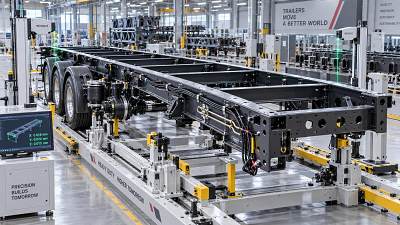
A serious semi trailer manufacturer should be able to show its welding process, jig accuracy, inspection records, and final testing routine.
Look closely at beam welding, alignment control, paint preparation, and brake system installation.
These are common areas where poor workmanship creates early failures.
Certification also matters, but documents should support real process control, not replace it.
Depending on the market, buyers often check ISO systems, welding qualifications, and roadworthiness compliance.
In actual sourcing, the stronger signal is whether the factory can connect each certificate to a working production procedure.
When a semi trailer manufacturer answers these points with detail, risk becomes easier to measure.
Is production capacity really important if the sample looks good?
Yes, because a good sample does not guarantee reliable delivery.
Many ordering problems come from scheduling pressure, subcontracted work, or parts shortages.
A capable semi trailer manufacturer should show realistic lead times, workshop throughput, and component sourcing stability.
This becomes critical for fleet expansion, project-based demand, or seasonal replacement cycles.
More importantly, production capacity is not only about volume.
It also includes engineering coordination, change control, and the ability to keep one specification consistent across units.
If order revisions are common, ask how technical changes are documented before production starts.
That question often reveals whether the supplier is process-driven or improvising.
Useful signs of stable delivery capability
- Clear production schedule linked to your order quantity
- Documented supplier network for axles, tires, and braking parts
- Factory photos or audit records showing active lines
- Export packing and shipping experience for similar destinations
- A defined procedure for delays, rework, or specification updates
In global sourcing, these details can be checked faster through an industry platform that aggregates suppliers and product categories.
That kind of visibility helps compare not just products, but also market positioning and supply chain maturity.
What makes one semi trailer manufacturer more suitable than another?
Suitability usually comes down to application fit, customization depth, and support after delivery.
Two suppliers may both offer flatbeds, yet one may better understand local axle regulations, overload realities, or rough-road reinforcement.
That difference matters far more than a small price gap.
Ask how the semi trailer manufacturer handles custom dimensions, landing gear position, twist locks, suspension options, and brake system compatibility.
Then check whether those custom choices are engineered properly or simply added on request.
After-sales support deserves equal attention.
A trailer that works well in theory can still become costly if spare parts, technical drawings, or claim handling are slow.
The better manufacturers usually provide parts lists, service guidance, and a defined warranty response path.
Questions that reveal real suitability
- Can the design match local legal dimensions and payload rules?
- Has the trailer been adapted for heat, humidity, dust, or poor roads?
- Are spare parts standardized or difficult to replace locally?
- How are warranty cases handled across borders?
Where do buyers make the biggest mistakes before ordering?
The most common mistake is comparing quotations without aligning specifications.
A lower price may reflect thinner steel, lower-grade axles, lighter suspension, or incomplete accessories.
Another mistake is assuming export experience automatically means market fit.
A semi trailer manufacturer may ship globally, yet still lack understanding of your operating conditions.
There is also a tendency to undercheck documentation.
Drawings, parts lists, inspection reports, and contract details reduce disagreement later.
Without them, even a good supplier relationship can become hard to manage.
A balanced evaluation reduces these mistakes and improves long-term fleet economics.
How can you use market information to make a better final decision?
A final decision is stronger when supplier review is combined with broader market context.
That includes checking brand presence, export activity, product breadth, and industry reputation.
A global heavy truck industry platform can support this stage by bringing together product listings, supplier comparisons, and category-level insight.
Instead of searching in fragments, buyers can review trailers, truck-related equipment, and spare parts in one ecosystem.
That matters because trailer sourcing is rarely isolated.
Brake components, landing gear, suspension parts, and service support all affect operating continuity.
In practice, the best choice is often the semi trailer manufacturer that combines acceptable cost with proven process control and dependable follow-up.
If several options look similar, compare them using the same scoring sheet and the same technical assumptions.
A smart next step before placing the order
List your operating environment, payload target, road conditions, and compliance needs first.
Then request aligned quotations, drawings, lead times, and warranty terms from each semi trailer manufacturer.
Once those details are visible side by side, the strongest option usually becomes clear.
A careful review now is far less expensive than correcting a poor trailer decision after delivery.
Trending News
- How to compare concrete mixer truck suppliers by total landed cost
- How axle load limits affect low bed trailer exports to Southeast Asia
- How to locate a truck exhaust system leak before replacing parts
- When does heavy equipment transport require a lowboy trailer?
- When does a light commercial vehicle for urban delivery save fleet costs?
Tag
Recommended News
 Buying GuideHow to compare concrete mixer truck suppliers by total landed costCompare truck cement mixer supplier quotes by total landed cost, including freight, duties, and delivery. Uncover hidden charges and choose the best-value truck for your fleet.
 Buying GuideWhen does heavy equipment transport require a lowboy trailer?Does your heavy equipment need a lowboy trailer? Discover how loaded height, weight distribution, loading access, and route limits determine the right choice for safe transport.
 Buying GuideHow to choose an off road truck for steep and unstable job sitesChoose the right off road truck for steep, unstable job sites. Compare traction, braking, stability, clearance, payload, and route-test essentials.
 Buying GuideHow to match crane truck lifting capacity to your jobsite loadsCrane truck capacity planning made clear: calculate gross load, radius, rigging, outriggers, and ground conditions to select safer, job-ready lifting equipment.
 Buying GuideHow to match lowbed trailer deck height to your hauling equipmentLowbed trailer deck height guide: match equipment clearance, ramp geometry, axle loads, tractor fit, and route limits for safer, more efficient hauling.
 Buying GuideWhat to verify before choosing a delivery truck supplier for school transportationDelivery truck supplier for school transportation: verify route fit, payload, safety, compliance, service support, and total cost before choosing a reliable partner.
 Buying GuideWhat an excavator manufacturer catalog should show before you compare modelsExcavator manufacturer catalog guide: verify supplier identity, configurations, hydraulics, compliance, parts support, and delivery readiness before comparing models.
 Buying GuideWhat to check before appointing a bulldozer distributorBulldozer distributor selection guide: evaluate service, parts availability, warranty, pricing, compliance, and lifecycle value to reduce downtime and protect fleet investment.
 Buying GuideWhat to verify before choosing a truck cement mixer supplierTruck cement mixer supplier checklist: verify chassis fit, drum quality, hydraulics, compliance, spare parts, and after-sales support before you buy.
 Buying GuideHow to verify a truck spare parts supplier before placing a bulk orderTruck spare parts supplier verification made practical: learn how to check part specifications, factory control, test records, samples, pricing, and delivery capability before placing a bulk order.
 Buying GuideWhat size truck container is right for a typical freight load?Truck container sizing made simple: compare payload, volume, pallet layouts, route access, and loading needs to choose the most efficient freight solution.
 Buying GuideWhat drives semi trailer price differences between similar models?Semi trailer price differences come down to frame materials, axles, suspension, coating, and configuration. Compare specifications line by line to choose lasting value.
 Buying GuideHow to compare excavator manufacturer price lists before requesting quotesCompare an excavator manufacturer price list with confidence. Learn to normalize configurations, calculate landed costs, assess options and service, and create stronger RFQs.
 Buying GuideHow to choose a mixer truck drum capacity for your concrete pourMixer truck capacity guide: match drum size to pour rate, legal payload, site access, and delivery cycles for efficient, reliable concrete placement.
 Buying GuideHow to size a bulldozer for construction site grading workBulldozer for construction sizing guide: match weight, blade, traction, grade control, and transport needs to improve grading productivity and costs.
 Buying GuideHow to assess a truck cement manufacturer’s build quality before orderingTruck cement manufacturer build quality: assess tank steel, welding, chassis integration, pneumatic systems, factory QC, and inspection evidence before ordering.
 Buying GuideWhen does a truck trailer OEM make sense for private-label fleets?Truck trailer OEM programs help private-label fleets cut lifecycle costs, standardize operations, and improve uptime. Learn when customization delivers real commercial value.
 Buying GuideWhat to verify before choosing a water truck OEM for your fleetWater truck OEM selection guide: verify chassis compatibility, tank quality, pump performance, compliance, and service support to build a safer, more reliable fleet.
 Buying GuideHow to size a cab chassis truck for a fire department apparatusCab chassis truck for fire department sizing guide: balance GVWR, axle loads, wheelbase, water tank placement, and mission needs for safer apparatus design.
 Buying GuideWhat to verify before choosing a truck chassis supplierChoose the right truck chassis supplier with a practical checklist for application fit, axle ratings, body integration, quality control, delivery reliability, and after-sales support.
 Buying GuideHow to choose a logging truck for steep and rough forest roadsLogging truck selection for steep, rough forest roads: compare traction, braking, gearing, chassis strength, tires, and supplier support for safer, more reliable hauling.
 Buying GuideHow to choose a flatbed trailer deck length for oversized loadsFlatbed trailer deck length guide for oversized loads: balance cargo support, axle weight, securement space, overhang, and route access for safer transport.
 Buying GuideHow to assess a truck chassis supplier for trailer manufacturingTruck chassis supplier for trailer manufacturing: learn how to assess technical fit, quality control, engineering support, and delivery reliability for smarter sourcing.
 Buying GuideIs the SHACMAN H3000 6×4 Cement Mixer suitable for large projects?SHACMAN H3000 6×4 Cement Mixer: assess payload, cycle time, traction, and service support to see if it can keep large concrete projects moving efficiently.
 Buying GuideHow to evaluate heavy duty trucks for sale in Russia before buyingHeavy duty trucks for sale in Russia: learn how to compare specifications, winter readiness, service support, supplier reliability, and total ownership costs before buying.