How to Evaluate a Truck Parts Supplier Beyond Unit Price
How to Evaluate a Truck Parts Supplier Beyond Unit Price
Choosing a truck parts supplier based only on unit price can create expensive problems later.
A cheaper brake drum, bearing, filter, or suspension part may look attractive during quotation review.
However, failures in service often cost far more than the original savings.
That risk is even higher in heavy-duty transport, construction, mining, and municipal operations.
The better approach is to evaluate a truck parts supplier through total operational value.
That includes product consistency, traceability, compliance, delivery reliability, and technical response after purchase.
In practice, these factors shape uptime, safety performance, warranty exposure, and long-term procurement cost.
This guide explains how to assess a truck parts supplier more strategically and make sourcing decisions with fewer blind spots.
Why Unit Price Is a Weak Standalone Metric
Unit price is easy to compare, which is why buyers often start there.
The problem is that price alone hides major differences between suppliers.
Two parts can share similar dimensions but perform very differently under load, heat, vibration, and contamination.
A low quote may reflect weaker raw materials, unstable process control, or limited inspection steps.
It may also reflect poor packaging, longer lead times, or inconsistent stock availability.
More importantly, a low-cost truck parts supplier can increase hidden costs across the fleet lifecycle.
- Higher failure rates and repeated replacement
- Unexpected vehicle downtime
- Safety incidents and regulatory exposure
- More inspection workload at receiving and installation stages
- Disputes over warranty claims and root-cause responsibility
- Emergency purchases at higher spot-market prices
When evaluating a truck parts supplier, total cost of ownership usually tells a more accurate story than line-item price.
Start with Product Quality Stability
Quality is not just about whether one sample passes inspection.
The real question is whether the truck parts supplier can deliver the same quality across batches.
Consistency matters more than a perfect first impression.
In recent sourcing cycles, this has become a stronger signal than aggressive pricing.
What to Check
- Raw material specifications and approved sources
- Dimensional tolerance control
- Mechanical performance testing
- Heat treatment records where applicable
- Surface treatment quality and corrosion resistance
- Batch-to-batch defect trends
Ask for inspection reports from multiple production lots, not just one recent sample.
A capable truck parts supplier should provide measurable data, not broad claims.
If quality data looks selective or incomplete, that is usually a warning sign.
Verify Manufacturing Traceability
Traceability separates serious suppliers from opportunistic traders.
When a part fails, you need to know where it came from, how it was made, and which batch is affected.
Without traceability, corrective action becomes slow, expensive, and uncertain.
This also affects recall management and customer complaint handling.
Key Traceability Questions
- Can the truck parts supplier link each shipment to a production batch?
- Are lot numbers marked on the part, label, or packaging?
- Can the supplier trace raw materials back to source mills or approved vendors?
- Are process records stored and retrievable?
- Is there a defined nonconformance and containment procedure?
A truck parts supplier with strong traceability usually manages risk better across the entire quality chain.
Review Certification and Compliance Carefully
Certificates matter, but only when they are relevant and current.
Many buyers stop at seeing a certificate logo on a brochure.
That is not enough for a meaningful supplier evaluation.
A reliable truck parts supplier should show valid documentation linked to actual operations and products.
- Quality management certifications such as ISO 9001
- Product-specific testing and compliance records
- Material safety and environmental compliance where required
- Market access documents for destination countries
- Audit records or third-party verification results
Check expiration dates, issuing bodies, and scope statements.
A certificate covering one factory does not automatically cover another workshop or subcontractor.
That detail often gets missed during urgent procurement.
Assess Delivery Reliability, Not Just Lead Time
A quoted lead time is only a promise until it is proven over repeated orders.
For heavy truck spare parts, timing affects maintenance schedules, inventory levels, and vehicle availability.
Even a technically strong truck parts supplier becomes risky if delivery performance is unstable.
Operational Signals to Review
Ask the truck parts supplier for recent performance data and customer references in similar operating environments.
Look at Technical Support and Failure Response
Good sourcing decisions continue after delivery.
When issues appear in the field, response speed becomes part of supplier value.
A dependable truck parts supplier should support root-cause analysis, replacement action, and preventive improvement.
This is especially important for safety-related parts and high-failure-cost components.
- Clear warranty terms
- Defined complaint handling process
- Technical contact with real product knowledge
- Corrective action reports within agreed timelines
- Support for sample analysis and field feedback
In actual operations, weak after-sales support often turns a manageable defect into a fleet-wide disruption.
Use a Risk-Based Supplier Scorecard
A structured scorecard makes evaluation more consistent across teams and product categories.
It also helps procurement explain why one truck parts supplier is worth a higher purchase price.
That matters when internal pressure focuses too heavily on short-term savings.
Suggested Evaluation Areas
- Product quality stability
- Manufacturing traceability
- Certification and compliance status
- Delivery performance
- Technical communication quality
- Warranty and corrective action speed
- Commercial terms and total cost
Weight each factor based on part criticality.
For example, brake components should carry heavier safety and traceability weighting than cosmetic accessories.
This creates a more realistic supplier selection method for truck parts procurement.
Why Platform Visibility Improves Supplier Evaluation
Supplier evaluation becomes easier when market information is transparent and comparable.
That is where a specialized industry platform adds practical value.
The Global Heavy Truck Industry Platform connects buyers, manufacturers, distributors, and component suppliers across the heavy truck supply chain.
This broader visibility helps teams compare a truck parts supplier beyond surface-level quotations.
Buyers can review supplier capabilities, product categories, market positioning, and supporting industry resources in one place.
That also supports faster shortlisting when sourcing spare parts for logistics, construction, mining, and infrastructure fleets.
A specialized B2B ecosystem does not replace audits, but it improves the quality of early screening.
Final Buying Questions Before You Commit
Before approving a new truck parts supplier, pause and test the decision with a few hard questions.
- Can this supplier prove stable quality over several batches?
- Can they trace defects quickly and contain risk?
- Are certifications valid and relevant to the supplied parts?
- Is delivery performance reliable under pressure?
- Will they respond effectively when field failures occur?
- Does the total value justify the commercial terms?
The strongest truck parts supplier is rarely the one with the lowest visible unit price.
It is the one that protects uptime, supports safety, and reduces uncertainty across the supply chain.
Use that standard in your next sourcing review, and your procurement decisions will become more defensible and more cost-effective over time.
Trending News
- How to assess a truck cement manufacturer’s build quality before ordering
- When does a truck trailer OEM make sense for private-label fleets?
- What to verify before choosing a water truck OEM for your fleet
- How to size a cab chassis truck for a fire department apparatus
- When does a truck off road setup need locking differentials?
Tag
Recommended News
 Truck Parts IndustryEU REACH Rule Takes Effect for Truck Rubber PartsEU REACH Rule takes effect for truck rubber parts exported to the EU. Learn how SCIP reporting, SVHC declarations, and supply chain compliance now impact truck manufacturers and suppliers.
 Truck Parts IndustryHow to Evaluate Commercial Vehicle Parts With Eco-Friendly Materials for Durability and ComplianceCommercial vehicle parts with eco-friendly materials require more than green claims. Learn how to assess durability, compliance, and supplier reliability for smarter sourcing.
 Truck Parts IndustryHow to Evaluate a Truck Parts Supplier Beyond Unit PriceTruck parts supplier selection should go beyond unit price. Learn how to assess quality, traceability, compliance, delivery, and support to reduce fleet risk and total cost.
 Truck Parts IndustryVietnam to Require QR Traceability Labels on Imported Heavy-Truck PartsVietnam to Require QR Traceability Labels on Imported Heavy-Truck Parts from Aug 1, 2026. Learn scope, VNQR-2025 rules, VITRAC links, and how to avoid port refusal and fines.
 Truck Parts IndustryHow to Evaluate a Truck Spare Parts Supplier for Long-Term Cost ControlTruck spare parts supplier selection affects far more than price. Learn how to compare quality, delivery, traceability, and hidden costs to protect fleet uptime and control long-term expenses.
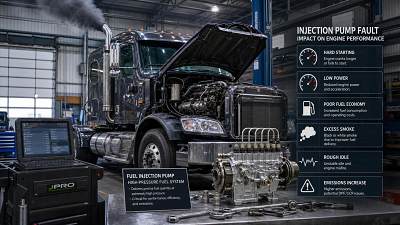
 Truck Parts IndustryFuel Injection Pump Failure Signs and What They Mean for Engine PerformanceFuel injection pump failure signs can quickly reduce truck power, raise fuel use, and trigger hard starts. Learn what each symptom means and when to act before costly downtime.
 Truck Parts IndustryExcavator Attachment Selection for Demolition and Site PrepExcavator attachment selection for demolition and site prep: compare breakers, grapples, crushers, and buckets to boost productivity, safety, and ROI.
 Truck Parts IndustryTruck Engine Overhaul or Replacement: Which Costs Less Long Term?Truck engine overhaul or replacement? Compare long-term cost, downtime, fuel efficiency, and reliability to choose the smarter option for your fleet.
 Truck Parts IndustryHow to Choose Excavator Parts That Last LongerExcavator parts buying guide: learn how to choose excavator parts that last longer by comparing fit, material quality, operating conditions, and supplier reliability.
 Truck Parts IndustryAre Eco-Friendly Commercial Vehicle Parts Durable Enough for Daily Use?Commercial vehicle parts with eco-friendly materials can be durable for daily use—if tested right. Explore where they perform best, key risks, and smarter sourcing insights.
 Truck Parts IndustryTruck Parts OEM vs Aftermarket: Cost, Fit, and Warranty RisksTruck parts OEM vs aftermarket: compare true cost, fit accuracy, and warranty risks to reduce downtime, avoid disputes, and make smarter fleet sourcing decisions.
 Truck Parts IndustryTruck Spare Parts Buying Guide: How to Reduce Downtime and Fitment RiskTruck spare parts buying guide for fleet maintenance teams: learn how to reduce downtime, avoid fitment risk, verify suppliers, and make smarter sourcing decisions.
 Truck Parts IndustryHow to Evaluate a Truck Parts Supplier Beyond PriceTruck parts supplier selection should go beyond price. Learn how to compare quality, delivery, service, and total cost to reduce risk and keep fleets running efficiently.
 Truck Parts IndustryHeavy Truck Parts for Construction: Signs of a Reliable ManufacturerHeavy truck parts manufacturer for construction: learn how to identify reliable suppliers through quality control, traceability, testing, and support to reduce downtime and improve fleet safety.
 Truck Parts IndustryHow to Compare Truck Spare Parts Suppliers on Quality and Lead TimeTruck spare parts supplier comparison starts with quality and lead time. Learn how to assess consistency, delivery reliability, and sourcing fit for smarter purchases.
 Truck Parts IndustryEU REACH Sets PAH Limit for Heavy Truck Rubber PartsEU REACH sets a new PAH limit for heavy truck rubber parts, affecting brake hoses, bushings, and export compliance. Learn what suppliers must prepare now to avoid testing delays and customs risks.
 Truck Parts IndustryWhat to Check in a Truck Chassis Supplier Before Fleet ExpansionTruck chassis supplier selection can make or break fleet expansion. Learn what to check on quality, production, delivery, support, and total cost before requesting a quote.
 Truck Parts IndustryCold Storage Truck Parts That Matter Most for Temperature ControlCommercial vehicle parts for cold storage determine real temperature stability. Discover the key truck components that reduce spoilage, improve efficiency, and protect sensitive cargo.
 Truck Parts IndustryHow to Evaluate a Heavy Truck Parts Manufacturer for Long-Term Supply StabilityHeavy truck parts manufacturer selection starts with supply stability. Learn how to assess quality, capacity, lead times, and risk signals for smarter long-term sourcing.
 Truck Parts IndustryEU EPR Rules Extend to Commercial TrailersEU EPR rules now extend to commercial trailers, bringing new registration, reporting, and fee duties from 2027. See how exporters can prepare early to avoid customs delays.
 Truck Parts IndustryTruck Suspension Problems: Signs, Causes, and Fix OptionsTruck suspension issues can lead to tire wear, poor handling, and costly downtime. Learn the key signs, root causes, and best fix options for different truck applications.
 Truck Parts IndustryHow to Choose a Heavy Truck Parts Manufacturer for Construction FleetsHeavy truck parts manufacturer for construction selection starts with uptime, quality, and delivery. Learn how to compare suppliers, reduce fleet risk, and choose with confidence.
 Truck Parts IndustryUS Sets AEBS Rule for Imported Commercial TrailersUS sets AEBS rule for imported commercial trailers starting Oct. 1, 2026. Learn FMVSS No. 127A, SAE J2929, and key compliance steps to avoid CBP entry denial.
 Truck Parts IndustryHow to Choose Commercial Vehicle Parts That Reduce DowntimeCommercial vehicle parts selection can make or break fleet uptime. Learn how to choose parts that improve fit, quality, supply reliability, and lower total downtime cost.
 Truck Parts IndustryTruck Parts Price Guide: What Drives Costs Up or DownTruck parts price guide: learn what raises or lowers costs, how to compare suppliers, and how to cut fleet risk with smarter, value-based sourcing decisions.