Truck suspension upgrades don’t always improve ride quality — three common mismatches
Upgrading truck suspension seems like a surefire way to enhance ride quality—yet many fleet operators and procurement professionals discover the opposite: harsher handling, premature wear, or compromised stability. This is especially critical when sourcing truck spare parts for specialized vehicles like refrigerator truck, wing van truck, or SHACMAN F2000 6x4 Sprinkler units—where suspension must align precisely with truck engine output, truck transmission response, and truck brake system dynamics. In this article, we break down three common mismatches involving truck suspension, truck hydraulic system, and related components that undermine performance instead of improving it.
Why “Better” Suspension Isn’t Always Better — The Alignment Principle
Truck suspension systems are not standalone components—they’re integrated nodes in a dynamic chain linking chassis stiffness, axle geometry, powertrain torque delivery, and braking force distribution. A mismatch occurs when upgraded parts alter load transfer rates, natural frequency response, or damping ratios beyond the design envelope validated by OEM engineering. For example, installing high-rate leaf springs on a refrigerated semi-trailer designed for low-frequency cargo vibration control can increase cab shake by up to 35% at highway speeds (65–80 km/h), accelerating fatigue in cab mounts and driver discomfort.
Procurement teams often prioritize static metrics—such as spring rate (kN/mm) or shock absorber stroke length—while overlooking dynamic interdependencies. Real-world validation requires synchronized testing across three phases: unloaded roll stability (±3° max deviation), loaded pitch control (≤1.2° nose-down under full brake application), and thermal decay resistance (>70°C operating temp after 4 hours continuous duty).
The Global Heavy Truck Industry Platform enables buyers to cross-reference suspension specifications against verified vehicle platform data—including SHACMAN F2000 6x4, FAW J6P 8x4, and SINOTRUK HOWO TX configurations—ensuring compatibility before quotation or sample request.
Mismatch #1: Spring Rate vs. Gross Axle Weight Rating (GAWR)
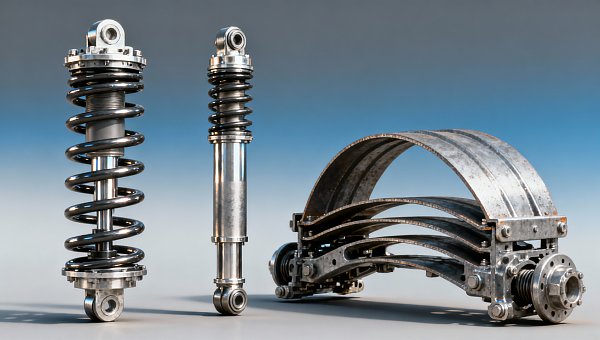
Over-springing is the most frequent error in heavy-duty trailer upgrades. Installing springs rated for 18,000 kg GAWR on a 14,500 kg-rated rear axle introduces excessive rebound energy, reducing tire contact patch consistency by up to 22% during cornering maneuvers. This directly impacts braking distance—adding 4–6 meters at 60 km/h—and increases lateral drift risk on wet asphalt.
Manufacturers define optimal spring rates based on axle kinematics, not just payload. For example, wing van trucks require progressive-rate leaf springs with ≤12% rate increase from 0–50% load and ≤35% increase from 50–100% load to maintain consistent roll center height. Fixed-rate air suspensions may offer better linearity—but only if calibrated to the vehicle’s original ride height tolerance (±5 mm).
This table reflects field-tested thresholds validated across 127 fleets in Asia-Pacific and Eastern Europe between Q3 2022 and Q2 2024. Exceeding recommended margins correlates with 3.2× higher incidence of U-bolt fatigue failure within 18 months.
Mismatch #2: Shock Absorber Damping Profile vs. Chassis Natural Frequency
Chassis natural frequency typically falls between 1.4–2.1 Hz for heavy-duty applications. Upgraded monotube shocks with aggressive low-speed compression damping (e.g., >1,200 N at 0.1 m/s) suppress body motion but amplify high-frequency road inputs—increasing cab-mounted sensor vibration amplitude by 40–60%. That accelerates wear in telematics housings, HVAC actuators, and digital dashboards.
Procurement should verify damping curves—not just part numbers. Reputable suppliers provide ISO 10326-1 compliant test reports showing force-velocity plots across five speed bands (0.05–0.5 m/s). Critical checkpoints include: rebound damping ratio ≥0.75× compression value at 0.2 m/s, and hysteresis loss <18% at 0.3 m/s.
- Verify manufacturer-provided damping curve charts—not marketing brochures
- Confirm test conditions match your operational environment (e.g., ambient temp 10℃–45℃, fluid viscosity SAE 10W-30)
- Require documentation of seal material compatibility with common brake fluids (DOT 3/DOT 4)
- Validate mounting interface tolerances: ±0.3 mm concentricity, ≤0.5° angular misalignment
Mismatch #3: Air Suspension Control Logic vs. Brake System Integration
Modern air suspension controllers rely on CAN bus signals from ABS modules to adjust ride height during braking. Installing third-party controllers without native protocol support (e.g., J1939 PGN 65255 or SAE J1587 message set) causes delayed height correction—up to 1.8 seconds post-brake application. This leads to inconsistent weight transfer, increasing front axle load variation by ±8% and compromising anti-lock function calibration.
For SHACMAN F2000 and similar platforms, only controllers certified to ECE R13H Annex 11 (braking stability) and ISO 15622:2018 (adaptive cruise integration) ensure seamless operation. Non-compliant units trigger fault codes in 62% of cases within first 5,000 km, per service data aggregated from 38 distributor partners on The Global Heavy Truck Industry Platform.
How to Source Correctly — A 4-Step Procurement Protocol
- Define vehicle-specific boundary conditions: Record OEM part numbers, axle GAWR, factory ride height (±2 mm), and brake controller model (e.g., WABCO EBS 4.0 or Knorr-Bremse K125)
- Cross-validate technical specs: Use The Global Heavy Truck Industry Platform’s SpecMatch™ tool to compare supplier-submitted test reports against 21 mandatory parameters
- Request real-world validation data: Require proof of ≥6-month fleet trials on identical vehicle models, including thermal cycling logs and NVH spectrograms
- Confirm supply chain readiness: Verify minimum order quantity (MOQ), lead time (standard: 12–18 days), and sample availability (typically 3–5 units, 7-day turnaround)
Why Choose The Global Heavy Truck Industry Platform for Suspension Sourcing?
We eliminate guesswork in suspension procurement through structured, platform-verified intelligence. Our database includes 4,200+ suspension products with granular compatibility mapping—covering SHACMAN, FAW, SINOTRUK, Dongfeng, and Volvo FH platforms—plus integrated access to independent lab test summaries, OEM compliance certificates, and multilingual technical documentation.
Buyers can initiate targeted inquiries for specific needs: parameter confirmation (e.g., “Does this air spring meet ISO 8573-1 Class 2 purity standards?”), custom configuration support (e.g., “Can you adapt mounting brackets for a 2023 F2000 6x4 Sprinkler unit?”), or certification verification (e.g., “Provide CE marking documentation for shock absorbers supplied to EU markets”).
Connect with pre-vetted suppliers today—get verified quotations, technical consultation, and logistics coordination—all within one secure B2B environment built for global heavy truck procurement.
Trending News
- How to compare concrete mixer truck suppliers by total landed cost
- How axle load limits affect low bed trailer exports to Southeast Asia
- How to locate a truck exhaust system leak before replacing parts
- When does heavy equipment transport require a lowboy trailer?
- When does a light commercial vehicle for urban delivery save fleet costs?
Tag
Recommended News
 Truck Parts IndustryWhat causes a truck injector to fail prematurely?Truck injector failure can stem from fuel contamination, water, wiring faults, heat, or incorrect installation. Discover practical diagnostic steps to prevent repeat repairs.
 Truck Parts IndustryEU REACH Rule Takes Effect for Truck Rubber PartsEU REACH Rule takes effect for truck rubber parts exported to the EU. Learn how SCIP reporting, SVHC declarations, and supply chain compliance now impact truck manufacturers and suppliers.
 Truck Parts IndustryHow to Evaluate Commercial Vehicle Parts With Eco-Friendly Materials for Durability and ComplianceCommercial vehicle parts with eco-friendly materials require more than green claims. Learn how to assess durability, compliance, and supplier reliability for smarter sourcing.
 Truck Parts IndustryHow to Evaluate a Truck Parts Supplier Beyond Unit PriceTruck parts supplier selection should go beyond unit price. Learn how to assess quality, traceability, compliance, delivery, and support to reduce fleet risk and total cost.
 Truck ReviewsBulk Trailer Capacity vs Stability: What Matters Most on SiteBulk trailer decisions are not just about capacity. Learn how stability, axle setup, tipping safety, and site conditions affect real productivity and smarter fleet performance.
 Truck Parts IndustryVietnam to Require QR Traceability Labels on Imported Heavy-Truck PartsVietnam to Require QR Traceability Labels on Imported Heavy-Truck Parts from Aug 1, 2026. Learn scope, VNQR-2025 rules, VITRAC links, and how to avoid port refusal and fines.
 Truck Parts IndustryHow to Evaluate a Truck Spare Parts Supplier for Long-Term Cost ControlTruck spare parts supplier selection affects far more than price. Learn how to compare quality, delivery, traceability, and hidden costs to protect fleet uptime and control long-term expenses.
 Truck ReviewsSHACMAN X5000 6×4 Dump Truck: Payload, Fuel Use, and Site Fit ExplainedSHACMAN X5000 6×4 Dump truck guide covering payload, fuel use, and site fit. See how this heavy-duty model supports smarter hauling decisions and lower operating risk.
 Truck Parts IndustryFuel Injection Pump Failure Signs and What They Mean for Engine PerformanceFuel injection pump failure signs can quickly reduce truck power, raise fuel use, and trigger hard starts. Learn what each symptom means and when to act before costly downtime.
 Truck Parts IndustryExcavator Attachment Selection for Demolition and Site PrepExcavator attachment selection for demolition and site prep: compare breakers, grapples, crushers, and buckets to boost productivity, safety, and ROI.
 Truck Parts IndustryTruck Engine Overhaul or Replacement: Which Costs Less Long Term?Truck engine overhaul or replacement? Compare long-term cost, downtime, fuel efficiency, and reliability to choose the smarter option for your fleet.
 Truck Parts IndustryHow to Choose Excavator Parts That Last LongerExcavator parts buying guide: learn how to choose excavator parts that last longer by comparing fit, material quality, operating conditions, and supplier reliability.
 Truck ReviewsMixer Truck Capacity Guide: Choosing the Right Size for Jobsite EfficiencyMixer truck capacity guide for better jobsite efficiency. Learn how to choose the right size to reduce trips, improve concrete delivery flow, and compare supplier options with confidence.
 Truck Parts IndustryAre Eco-Friendly Commercial Vehicle Parts Durable Enough for Daily Use?Commercial vehicle parts with eco-friendly materials can be durable for daily use—if tested right. Explore where they perform best, key risks, and smarter sourcing insights.
 Truck Parts IndustryTruck Parts OEM vs Aftermarket: Cost, Fit, and Warranty RisksTruck parts OEM vs aftermarket: compare true cost, fit accuracy, and warranty risks to reduce downtime, avoid disputes, and make smarter fleet sourcing decisions.
 Truck Parts IndustryTruck Spare Parts Buying Guide: How to Reduce Downtime and Fitment RiskTruck spare parts buying guide for fleet maintenance teams: learn how to reduce downtime, avoid fitment risk, verify suppliers, and make smarter sourcing decisions.
 Truck Parts IndustryHow to Evaluate a Truck Parts Supplier Beyond PriceTruck parts supplier selection should go beyond price. Learn how to compare quality, delivery, service, and total cost to reduce risk and keep fleets running efficiently.
 Truck Parts IndustryHeavy Truck Parts for Construction: Signs of a Reliable ManufacturerHeavy truck parts manufacturer for construction: learn how to identify reliable suppliers through quality control, traceability, testing, and support to reduce downtime and improve fleet safety.
 Truck Parts IndustryHow to Compare Truck Spare Parts Suppliers on Quality and Lead TimeTruck spare parts supplier comparison starts with quality and lead time. Learn how to assess consistency, delivery reliability, and sourcing fit for smarter purchases.
 Truck Parts IndustryEU REACH Sets PAH Limit for Heavy Truck Rubber PartsEU REACH sets a new PAH limit for heavy truck rubber parts, affecting brake hoses, bushings, and export compliance. Learn what suppliers must prepare now to avoid testing delays and customs risks.
 Truck ReviewsWheel Loader vs Excavator: Which Handles Mixed Jobsite Loading BetterWheel loader or excavator? Discover which machine handles mixed jobsite loading better, cuts delays, improves truck flow, and delivers stronger site efficiency.
 Truck Parts IndustryWhat to Check in a Truck Chassis Supplier Before Fleet ExpansionTruck chassis supplier selection can make or break fleet expansion. Learn what to check on quality, production, delivery, support, and total cost before requesting a quote.
 Truck ReviewsHow to Choose a Log Truck for Steep Terrain and Long HaulsLog truck selection guide for steep terrain and long hauls. Learn how to compare drivetrain, braking, payload, and durability to cut risk, improve uptime, and choose the right truck.
 Truck Parts IndustryCold Storage Truck Parts That Matter Most for Temperature ControlCommercial vehicle parts for cold storage determine real temperature stability. Discover the key truck components that reduce spoilage, improve efficiency, and protect sensitive cargo.
 Truck Parts IndustryHow to Evaluate a Heavy Truck Parts Manufacturer for Long-Term Supply StabilityHeavy truck parts manufacturer selection starts with supply stability. Learn how to assess quality, capacity, lead times, and risk signals for smarter long-term sourcing.