Manual or Automated Truck Gearbox for Long-Haul Efficiency?
Choosing between a manual and automated truck gearbox can significantly affect fuel economy, driver fatigue, uptime, and total operating cost in industrial transportation. For buyers, fleet managers, and distributors evaluating truck fleet performance, the right transmission also impacts compatibility with engine assembly, truck turbocharger efficiency, and long-haul reliability. This guide explores how each truck gearbox option supports different operating needs and purchasing strategies.
For most modern long-haul operations, an automated truck gearbox is usually the better choice for efficiency, consistency, and driver comfort. However, a manual truck gearbox can still make sense in specific cases, especially where purchase budget is tight, service capability is strong, and routes or driver preferences favor direct control. The best decision depends less on theory and more on duty cycle, driver mix, terrain, maintenance support, and total lifecycle cost.
What Buyers Really Need to Decide First
When people search for “manual or automated truck gearbox for long-haul efficiency,” they are rarely looking for a simple technical definition. They usually want to know which option will lower operating cost, reduce driver fatigue, improve fuel economy, and deliver more reliable performance over long distances.
For procurement teams, distributors, and business evaluators, the most practical questions are:
- Which gearbox improves fuel efficiency in real-world long-haul use?
- Which option reduces driver-related variability?
- How does the transmission affect maintenance cost and uptime?
- Which specification is easier to support across fleets and markets?
- How should transmission choice align with engine, driveline, and route conditions?
These are the issues that directly influence ROI, resale value, and fleet standardization. That is where the decision should begin.
Overall Verdict: Automated Gearboxes Usually Win in Long-Haul Efficiency
In most highway and cross-border freight applications, automated manual transmissions, often referred to as AMTs, provide better long-haul efficiency than traditional manuals. Their main advantage is consistency. They shift at optimized points, reduce missed shifts, protect the driveline from poor driving habits, and help keep the engine operating in its most efficient torque range.
This matters because long-haul efficiency is not only about theoretical fuel consumption. It also includes:
- Lower driver fatigue over extended hours
- More predictable fuel usage across different drivers
- Reduced clutch wear caused by operator technique
- Better integration with modern engine management systems
- Improved fleet control and easier driver onboarding
Manual gearboxes remain relevant, but in pure long-distance transport with high mileage and pressure for operational consistency, automated systems often deliver stronger business value.
Fuel Economy: Where the Biggest Efficiency Difference Appears
Fuel cost is one of the largest expenses in heavy truck operations, so transmission choice has a direct impact on profitability. An automated truck gearbox can improve fuel economy because it selects gears according to programmed shift logic, road speed, load, and engine parameters. This helps the truck stay in the optimal rev range more consistently than many manual drivers can maintain over long routes.
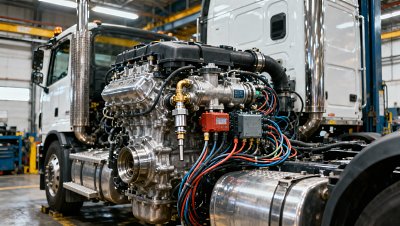
Automated systems are especially effective when paired with modern diesel engine assembly and truck turbocharger systems. Since turbocharged heavy-duty engines perform best within specific torque bands, a transmission that shifts accurately and consistently supports combustion efficiency and better power delivery.
Manual gearboxes can still be efficient in the hands of highly skilled drivers. In fleets with experienced operators and stable route profiles, a manual may produce competitive fuel figures. But from a buyer’s perspective, the question is not whether the best driver can match AMT performance. The question is whether the whole fleet can do so consistently. In most cases, the answer favors automation.
Driver Fatigue, Recruitment, and Operational Stability
Long-haul efficiency is also a human issue. Driver fatigue reduces concentration, affects gear selection quality, and can increase accident and maintenance risk. Automated transmissions reduce physical workload because the driver does not need to manage clutch engagement and manual shifting continuously, especially in traffic, gradients, or mixed road conditions.
This has several operational benefits:
- Easier adaptation for new drivers
- Less fatigue during long-distance runs
- Reduced training complexity
- More stable driving performance across the fleet
- Higher driver acceptance in many markets
For distributors and fleet buyers, this is increasingly important. In regions facing driver shortages, trucks equipped with automated gearboxes may be easier to place, easier to sell, and more attractive to transport operators trying to improve retention.
Maintenance, Uptime, and Long-Term Cost
Some buyers assume a manual truck gearbox is always cheaper because the purchase price is lower and the technology is familiar. That can be true at the initial acquisition stage. But long-haul purchasing decisions should focus on total operating cost rather than only upfront cost.
Automated gearboxes often help lower long-term wear caused by inconsistent shifting, clutch abuse, and driveline shock. They can reduce damage associated with operator error and improve component life in fleets with multiple drivers. In well-supported markets, this can translate into stronger uptime and better cost control.
At the same time, AMTs depend more on electronics, calibration, and software diagnostics. If local service networks are weak or spare parts support is limited, a manual gearbox may remain the safer operational choice. This is especially relevant for buyers sourcing trucks for remote regions or emerging markets where repair simplicity is a major advantage.
So the maintenance question is not simply “Which one breaks less?” It is “Which one can be maintained more reliably in my operating environment?”
When a Manual Truck Gearbox Still Makes Sense
Although automated transmissions are becoming the preferred solution for long-haul trucks, manual gearboxes are still practical in several scenarios:
- Purchase budget is highly constrained
- Drivers are already trained and prefer manual control
- Workshop teams are more experienced with mechanical repairs than electronic diagnostics
- Operating regions have limited support for advanced transmission systems
- Fleet owners prioritize lower acquisition cost over optimization features
Manual gearboxes may also remain useful in certain mixed-use conditions where operators want full control over gearing strategy. However, for standardized high-mileage freight work, they are increasingly a niche choice rather than the default option.
How Transmission Choice Affects Procurement and Product Matching
For B2B buyers and sourcing professionals, gearbox selection should not be separated from the full vehicle specification. Transmission performance is closely connected to engine output, rear axle ratio, expected payload, terrain, and cruising speed. A truck gearbox that looks efficient on paper may perform poorly if it is mismatched with the rest of the driveline.
During supplier evaluation, buyers should ask:
- What engine and gearbox pairing is recommended for long-haul duty?
- How does the transmission support fuel-saving strategy at highway speeds?
- What service network exists for diagnostics and parts supply?
- What are the clutch life expectations under typical load conditions?
- Is the gearbox proven in export markets with similar terrain and regulations?
- How does the transmission affect resale value in the destination market?
For distributors and agents, these questions are also critical for product positioning. A transmission that fits local driver habits and service capability may be more commercially successful than a technically advanced option that lacks aftersales support.
Best Choice by Operating Scenario
The fastest way to make a practical decision is to match the gearbox to the actual transport scenario.
- Highway long-haul fleets with high annual mileage: automated gearbox is usually the best choice
- Cross-border logistics with multiple drivers: automated gearbox offers better consistency and reduced misuse risk
- Owner-operators with strong manual driving skill and tight budgets: manual gearbox may still be viable
- Remote markets with limited diagnostic support: manual gearbox can offer easier maintenance
- Fleets focused on driver comfort and retention: automated gearbox is generally more attractive
- Buyers seeking modern fleet standardization: automated gearbox is usually more future-ready
In other words, the more a business values consistency, fuel optimization, and lower driver burden, the stronger the case for automation.
What This Means for Global Buyers, Distributors, and Evaluators
For international buyers using a heavy truck industry platform to compare products and suppliers, gearbox selection should be treated as a business decision, not just a mechanical preference. The right choice can improve route profitability, reduce operating variability, and strengthen customer acceptance in target markets.
Automated truck gearboxes align well with current market trends in long-haul transportation, especially where fleets want better fuel management, easier driver recruitment, and stronger compatibility with modern powertrain systems. Manual gearboxes remain relevant where cost pressure, maintenance simplicity, or local operating conditions make them the more practical solution.
The key is to compare trucks based on full application logic: route profile, service conditions, local repair ecosystem, driver structure, and lifecycle economics.
Conclusion
If the goal is long-haul efficiency in today’s heavy truck market, an automated truck gearbox is the best option in most cases. It usually delivers better fuel consistency, less driver fatigue, smoother powertrain integration, and stronger fleet-level performance. A manual gearbox still has value where budgets are tighter and maintenance conditions favor simpler mechanical systems, but it is no longer the automatic first choice for long-distance transport.
For buyers, procurement managers, and distributors, the smartest approach is to evaluate transmission choice as part of the complete truck specification and operating model. When matched correctly to route demands, driver capability, and service support, the gearbox becomes a major contributor to uptime, cost control, and long-term commercial success.
Trending News
- Wuhu MSA Issues Yellow Fog Warning, Affecting Roll-on/Roll-off Operations on Wanjiang River
- Yangtze River Navigational Draft Adjustment Affects Ro-Ro Heavy Truck Transport
- Yichang Yidu MSA Issues Orange Fog Warning, Temporarily Halts Ro-Ro Vessel Traffic at Three Gorges Dam
- Chongqing MSA Adjusts Ship Transit Plan at Three Gorges–Gezhouba Locks
- China to Boost Truck Containerization at Key Rail Hubs by 2026
Tag
Recommended News
 Truck TechnologyTC521 Advances Smart Heavy-Duty Truck Remote Diagnostics StandardTC521's new smart heavy-duty truck remote diagnostics standard mandates ISO 27145-2 & EU eCall compliance—critical for 2027 EU type-approval. Act now.
 Truck TechnologyTC521 Advances Smart Heavy-Duty Truck Remote Diagnostics StandardTC521 advances smart heavy-duty truck remote diagnostics standard—mandating UDS + OBD-II for EU-bound trucks. Act now to ensure compliance & market access.
 Truck TechnologyIntermittent faults in a truck electrical system are harder than they lookTruck electrical system faults can silently affect the truck control unit, truck fuel system, and truck cooling system. Learn how to spot hidden risks, cut downtime, and choose reliable truck parts and suppliers.
 Truck TechnologyTruck cab redesign trends that are changing driver comfort in 2026Explore 2026 truck cab trends with truck cab, truck steering system, truck cooling system, truck electrical system and truck control unit insights for smarter B2B sourcing.
 Truck TechnologyWhy some truck fuel systems lose efficiency after injector serviceTruck fuel system efficiency can drop after injector service due to truck pump, truck control unit, or truck electrical system faults. Learn the real causes and reduce fleet repair risk.
 Truck TechnologyTruck Tipper Body Material Affects More Than DurabilityTruck tipper body material shapes payload, fuel use, and hydraulic pump efficiency. Compare truck trailer, off road truck, and wheel loader needs to choose smarter, lower-cost fleet performance.
 Truck TechnologyTruck Off Road Use Cases That Demand a Different Axle SetupTruck off road axle guide for off road truck, truck tipper, truck trailer and wheel loader fleets. Compare hydraulic pump support, truck battery and truck concrete demands to choose durable setups.
 Truck TechnologyYangtze's First Spatial-Intelligent Cruise 'Changjiang Xing · Lanyue' ArrivesYangtze's first spatial-intelligent cruise 'Changjiang Xing · Lanyue' arrives — driving global demand for ISO 8712:2026-compliant inland-port EV tractors & shore charging systems.
 Truck TechnologyTruck Dumper Downtime Often Starts With One Overlooked CheckTruck dumper downtime often starts with one missed check. Learn how truck logging, truck steel, truck skeleton, truck lighting system, and truck air system reviews help cut failures and improve sourcing.
 Truck TechnologyTruck Spreader Calibration Problems That Lead to Material WasteTruck spreader calibration issues can cause major material waste. Learn how truck dumper, truck wing, truck air system, and truck lighting system design affect accuracy, cost, and smarter fleet sourcing.
 Truck TechnologyTruck Lighting System Upgrades That Improve Night Route SafetyTruck lighting system upgrades improve night safety, visibility, and uptime across truck dumper, truck logging, truck excavator, truck wing, and truck spreader fleets.
 Truck TechnologyWhat a Slow-Building Truck Air System Says About Brake ReliabilityTruck air system issues can reveal brake reliability risks across truck dumper, truck logging, truck excavator and truck lighting system applications. Learn what slow pressure build-up says before you buy.
 Truck TechnologyOff-road truck frame rail thickness specs vary widely — but not all meet ISO 12109 standardsDiscover ISO 12109–compliant off-road truck frames for truck military, lowbed, dozer & concrete applications—boost payload, cut maintenance, ensure global compliance.
 Truck TechnologyConcrete truck water-cement ratio control relies heavily on pump consistency — here’s whyHydraulic pump consistency is critical for precise water-cement ratio control in truck concrete—ensuring quality, compliance & lower TCO. Explore proven solutions for truck off road, military, lowbed, and bulk applications.
 Truck TechnologyHydraulic pump efficiency drops faster in stop-start urban delivery cycles than highway useHydraulic pump efficiency drops 3.2× faster in urban stop-start cycles—critical for logistics truck, truck concrete, truck military & more. Optimize TCO now.
 Truck TechnologyDozer truck hydraulic flow demand often exceeds standard auxiliary circuit capacityHydraulic pump flow demand in dozer truck, truck off road, and truck military applications often exceeds standard auxiliary capacity—verify certified high-flow solutions for truck concrete, lowbed, bulk, and leasing fleets.
 Truck TechnologyOff-road truck tire pressure charts rarely match actual terrain load distributionTruck off road, truck dozer & truck lowbed fleets: Discover why standard tire pressure charts fail—and how terrain-aware calibration boosts traction, tire life & fuel injection pump efficiency.
 Truck TechnologyConcrete truck drum rotation speed: Why ‘just fast enough’ causes uneven mixingOptimize hydraulic pump, fuel injection pump & transmission gearbox performance—discover why precise concrete truck drum rotation speed prevents segregation, cuts truck maintenance costs, and boosts ROI for logistics truck, lowbed, military, and off-road fleets.
 Truck TechnologyTruck sealer performance drops sharply below -5°C — alternatives that hold up in winterTruck sealer fails below –5°C? Discover cold-rated alternatives for hydraulic pump, fuel injection pump & transmission gearbox—proven in truck military, off road, lowbed & bulk applications.
 Truck TechnologyHow military-spec truck chassis differ from commercial off-road variants in real-world durabilityDiscover how military-spec truck chassis outperform commercial off-road variants in durability, hydraulic pump reliability, fuel injection pump resilience, and transmission gearbox strength—key for logistics truck, truck lowbed, and truck dozer operations.
 Truck TechnologyTruck air system moisture traps: do integrated desiccants reduce service intervals?Truck air system moisture traps with integrated desiccants—ideal for truck dumper, excavator & logging fleets. Do they cut service intervals? Real-world data reveals the truth.
 Truck TechnologyTruck lighting system upgrades: when LED retrofits improve night safety more than complianceUpgrade your truck lighting system with LED retrofits for superior night safety—ideal for truck dumper, logging, excavator, wing, spreader, injector, steel, skeleton & air systems.
 Truck TechnologyTruck injector compatibility: why not all DEF systems work with Euro VI enginesTruck injector compatibility is critical for Euro VI trucks—avoid failures in truck dumper, logging, excavator & spreader fleets. Verify DEF system alignment now.
 Truck TechnologyWhy truck logging systems now require real-time GPS + load verificationTruck dumper, excavator, spreader & injector fleets now demand real-time GPS + load verification—boost compliance, safety & ROI. Discover certified truck logging systems.
 Truck TechnologyCAAC Releases New ATC License Rules, Impacts Smart Tug SystemsSmart tug systems face new technical benchmarks: CAAC’s ATC license rules now shape AI scheduling, positioning redundancy & V2X standards for global logistics exports.