Lithium Rebound Lifts E-Truck Battery Costs
The timing of the event is not explicitly stated in the source input, but the development itself is clear: a rebound in battery-grade lithium carbonate prices has pushed up battery costs for electric heavy trucks, while the build-out of megawatt-class ultra-fast charging is easing operating concerns in high-frequency short-haul scenarios. This is worth close attention from truck OEMs, fleet operators, charging and battery-swap service providers, and procurement teams, because it highlights a market in which vehicle cost pressure and operating efficiency are moving in different directions at the same time.
What the reported market shift confirms
According to the provided information, staged contraction in lithium extraction capacity at South American salt lakes contributed to a rebound in battery-grade lithium carbonate prices. By mid-June 2026, the quoted price had returned to RMB 148,000 per ton, up 12% month on month.
The same input states that this price move has raised the cost of electric heavy-truck batteries and, in turn, increased complete vehicle costs for new energy heavy trucks.
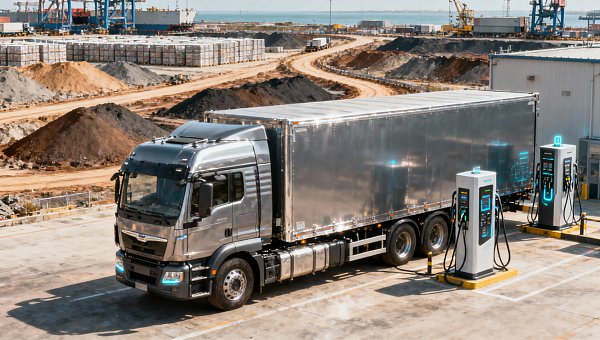
At the same time, megawatt-level ultra-fast charging stations have already expanded to cover 32 provincial-level administrative regions nationwide. In short-haul operating environments such as ports, steel mills, and mines, charging time has reportedly been reduced to within 12 minutes.
The provided summary also notes that overseas mining and port operators still see a total cost of ownership advantage and are accelerating bulk purchases of Chinese battery-swap heavy trucks as well as customized integrated charging-and-swapping solutions.
Where the pressure and relief are appearing across the value chain
Vehicle makers face a more difficult cost pass-through question
From an industry perspective, electric heavy-truck manufacturers may feel the impact first through battery-related cost pressure. The main business issue is not only component pricing, but also whether procurement, pricing, and delivery commitments can remain aligned when raw material quotations rebound.
Fleet buyers are likely to weigh purchase price against operating rhythm
Analysis shows that logistics operators in ports, steel plants, and mining haulage are likely to focus less on sticker price alone and more on whether fast replenishment can protect asset utilization. The reported reduction of charging time to within 12 minutes changes the operating discussion, especially for fleets that depend on tight turnaround cycles.
Charging and swapping service providers gain strategic relevance
Observably, infrastructure providers may be affected in a different way from vehicle manufacturers. Even when vehicle costs rise, wider megawatt charging coverage and integrated charging-and-swapping offers can become more central to customer decision-making, because they directly address downtime and route feasibility.
Overseas project buyers may prioritize solution completeness
For mining and port operators outside China, the input suggests that procurement interest remains active because TCO advantages are still being recognized. What deserves closer attention is whether buyers increasingly assess not just the truck itself, but also the bundled ability to deliver customized energy replenishment solutions at scale.
What companies should monitor now
Track whether raw material pressure proves temporary or persistent
Analysis shows that procurement and planning teams should closely monitor whether the reported supply-side contraction remains a short-term disturbance or develops into a longer-lasting constraint. That distinction matters for quoting strategy, contract timing, and inventory coordination.
Recheck scenario economics, not only vehicle pricing
For companies serving ports, steel mills, and mines, it is worth reassessing economics at the application-scenario level. The current signal is that higher battery costs do not automatically erase the business case if charging or swapping efficiency materially reduces downtime.
Align delivery commitments with energy infrastructure readiness
What deserves closer attention is the match between vehicle deployment plans and actual charging or battery-swap support. For suppliers and project teams, customer communication should remain tied to verifiable infrastructure coverage, replenishment speed, and implementation conditions rather than general market narratives.
Prepare for more customized procurement discussions overseas
Observably, overseas buyers in mining and port applications may increasingly ask for integrated delivery rather than stand-alone vehicle supply. That means sales, engineering, and supply-chain teams may need to prepare for longer discussions around customized charging-and-swapping packages, fulfillment timing, and operational support.
Why this looks like a mixed signal rather than a single-direction market move
Analysis shows that this development should not be read only as a cost increase story. The same piece of information points to two simultaneous realities: upstream lithium pricing has rebounded enough to raise battery costs, while downstream charging infrastructure has improved enough to reduce operational anxiety in key heavy-duty use cases.
It is more appropriate to understand this as a market signal of shifting competitive factors. In the near term, raw material fluctuations can affect procurement and vehicle pricing. At the same time, operating efficiency, charging turnaround, and integrated energy solutions are becoming more important in how buyers evaluate heavy-truck electrification.
Further observation is still necessary, especially on whether the current lithium price rebound continues and whether the reported TCO advantage remains strong across additional overseas orders and deployment scenarios.
How to read the current industry meaning
At this stage, the more balanced interpretation is that the electric heavy-truck market is facing short-term cost pressure without losing its operational logic in high-frequency industrial transport. The confirmed facts do not support a simple bullish or bearish conclusion. Instead, they suggest that procurement decisions may increasingly depend on how effectively companies combine vehicle supply, charging or swapping access, and scenario-based cost control.
Basis of this article and points for follow-up verification
This article is generated based on the user-provided news title, unspecified event timing, and event summary. The input does not provide a specific official source link, so the underlying details still require continued verification against source types that commonly matter for this kind of industry update, such as official announcements, company statements, industry association information, authoritative media reporting, and standard-setting documents.
Areas that merit follow-up include whether lithium supply conditions change further, whether pricing remains at or near the reported level, and how quickly bulk procurement of Chinese battery-swap heavy trucks and customized charging-and-swapping solutions translates into confirmed project execution.
Trending News
- How to compare concrete mixer truck suppliers by total landed cost
- How axle load limits affect low bed trailer exports to Southeast Asia
- How to locate a truck exhaust system leak before replacing parts
- When does heavy equipment transport require a lowboy trailer?
- When does a light commercial vehicle for urban delivery save fleet costs?
Tag
Recommended News
 Buying GuideHow to compare concrete mixer truck suppliers by total landed costCompare truck cement mixer supplier quotes by total landed cost, including freight, duties, and delivery. Uncover hidden charges and choose the best-value truck for your fleet.
 Policy & RegulationsHow axle load limits affect low bed trailer exports to Southeast AsiaPlanning low bed trailer export to Southeast Asia? Learn how axle load limits affect legal payload, axle layouts, and route compliance to avoid costly mistakes before ordering.
 Truck TechnologyHow to locate a truck exhaust system leak before replacing partsLocate a truck exhaust system leak before replacing parts. Learn how to spot soot trails, confirm leaks safely, and identify root causes to avoid costly guesswork and repeat repairs.
 Buying GuideWhen does heavy equipment transport require a lowboy trailer?Does your heavy equipment need a lowboy trailer? Discover how loaded height, weight distribution, loading access, and route limits determine the right choice for safe transport.
 Fleet ManagementWhen does a light commercial vehicle for urban delivery save fleet costs?Light commercial vehicle for urban delivery: learn when route density, payload utilization, access, and driver productivity can reduce fleet cost per successful stop.
 Buying GuideHow to choose an off road truck for steep and unstable job sitesChoose the right off road truck for steep, unstable job sites. Compare traction, braking, stability, clearance, payload, and route-test essentials.
 Buying GuideHow to match crane truck lifting capacity to your jobsite loadsCrane truck capacity planning made clear: calculate gross load, radius, rigging, outriggers, and ground conditions to select safer, job-ready lifting equipment.
 Transportation CostsWhat drives logging truck cost beyond the base purchase price?Logging truck cost goes far beyond the base price. Explore chassis, cranes, trailers, fuel, compliance, and support factors to make a smarter timber-hauling investment.
 Buying GuideHow to match lowbed trailer deck height to your hauling equipmentLowbed trailer deck height guide: match equipment clearance, ramp geometry, axle loads, tractor fit, and route limits for safer, more efficient hauling.
 Truck ExportWhat documents are needed to export a low bed trailer to Southeast Asia?Low bed trailer export to Southeast Asia: discover essential shipping, customs, origin, and technical documents to avoid delays and ensure smooth import clearance.
 Buying GuideWhat to verify before choosing a delivery truck supplier for school transportationDelivery truck supplier for school transportation: verify route fit, payload, safety, compliance, service support, and total cost before choosing a reliable partner.
 Buying GuideWhat an excavator manufacturer catalog should show before you compare modelsExcavator manufacturer catalog guide: verify supplier identity, configurations, hydraulics, compliance, parts support, and delivery readiness before comparing models.
 Buying GuideWhat to check before appointing a bulldozer distributorBulldozer distributor selection guide: evaluate service, parts availability, warranty, pricing, compliance, and lifecycle value to reduce downtime and protect fleet investment.
 Truck ExportHow to verify supplier reliability when sourcing bulldozers overseasBulldozer sourcing made safer: learn how to verify overseas suppliers, inspect quality, confirm specifications, manage export documents, and reduce lifecycle risk.
 Buying GuideWhat to verify before choosing a truck cement mixer supplierTruck cement mixer supplier checklist: verify chassis fit, drum quality, hydraulics, compliance, spare parts, and after-sales support before you buy.
 Buying GuideHow to verify a truck spare parts supplier before placing a bulk orderTruck spare parts supplier verification made practical: learn how to check part specifications, factory control, test records, samples, pricing, and delivery capability before placing a bulk order.
 Buying GuideWhat size truck container is right for a typical freight load?Truck container sizing made simple: compare payload, volume, pallet layouts, route access, and loading needs to choose the most efficient freight solution.
 Buying GuideWhat drives semi trailer price differences between similar models?Semi trailer price differences come down to frame materials, axles, suspension, coating, and configuration. Compare specifications line by line to choose lasting value.
 Truck Parts IndustryWhat causes a truck injector to fail prematurely?Truck injector failure can stem from fuel contamination, water, wiring faults, heat, or incorrect installation. Discover practical diagnostic steps to prevent repeat repairs.
 Buying GuideHow to compare excavator manufacturer price lists before requesting quotesCompare an excavator manufacturer price list with confidence. Learn to normalize configurations, calculate landed costs, assess options and service, and create stronger RFQs.
 Truck TechnologyDoes a cab chassis truck for fire department have enough frame capacity?Cab chassis truck for fire department: assess frame strength, axle loads, tank weight, stability and compliance for a safer, reliable fire apparatus build.
 Buying GuideHow to choose a mixer truck drum capacity for your concrete pourMixer truck capacity guide: match drum size to pour rate, legal payload, site access, and delivery cycles for efficient, reliable concrete placement.
 Buying GuideHow to size a bulldozer for construction site grading workBulldozer for construction sizing guide: match weight, blade, traction, grade control, and transport needs to improve grading productivity and costs.
 Buying GuideHow to assess a truck cement manufacturer’s build quality before orderingTruck cement manufacturer build quality: assess tank steel, welding, chassis integration, pneumatic systems, factory QC, and inspection evidence before ordering.
 Buying GuideWhen does a truck trailer OEM make sense for private-label fleets?Truck trailer OEM programs help private-label fleets cut lifecycle costs, standardize operations, and improve uptime. Learn when customization delivers real commercial value.