How to choose a supplier of portable construction machinery
The right construction machinery supplier with portable options should be able to match equipment mobility to the way your projects actually move. A machine that is easy to tow may still require a separate power source, lifting equipment, road permits, or several hours of setup before it can work. Those requirements affect the delivery schedule and the true cost of every relocation.
For procurement teams, the decision comes down to three questions: Can the equipment perform the required work at each site? Can it be moved and commissioned with the resources available? And can the supplier keep it operating throughout the project? Use the answers to compare suppliers on operational fit, landed cost, and support rather than purchase price alone.
Define what portability means for your project
“Portable” describes a range of machines, from compact equipment that can be loaded onto a vehicle to trailer-mounted units designed for towing. Neither configuration is automatically suitable for every job. The useful definition is whether your team can move, position, connect, and operate the equipment within the constraints of the project.
Start with the complete transport configuration. Ask for the machine’s dimensions and weight as shipped and as moved between sites, including any frame, trailer, attachments, guards, or accessories needed for normal operation. A compact unit may fit through a site entrance but exceed the capacity of the truck or lifting equipment available to unload it.
Then consider the route and the destination. Public roads, bridges, urban access restrictions, soft ground, narrow entrances, and overhead obstructions can each change the transport plan. Trailer-mounted machinery may be convenient for frequent moves when a suitable towing vehicle and qualified operator are available. A skid-mounted unit may make more sense when a truck and lifting equipment are already part of the operation, but it can be inconvenient for small teams moving between sites without unloading support.
Portability also includes readiness to work. Establish whether the unit needs a foundation or level surface, fuel, electrical power, water, ventilation, or connections to other equipment. Ask how it is secured for transport and what must be disconnected before moving. A low transport footprint has limited value if setup repeatedly delays the crew.
Match machine capacity to the work, not the brochure
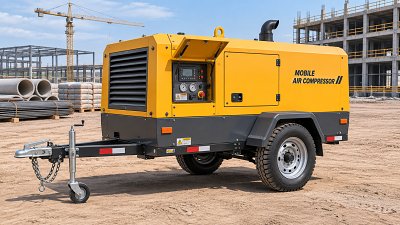
Provide suppliers with a representative duty profile: the material or task, expected working hours, operating conditions, site constraints, and the busiest part of the job. For a portable concrete mixer, for example, the relevant question is whether it can supply the required work at the pace the crew can place material. For a mobile compressor, the connected tools and their combined air demand matter more than a headline description of portability.
Request the operating capacity under conditions relevant to the proposed application, together with the power or fuel requirements. Clarify whether stated capacity assumes continuous operation, a particular material, or an attachment supplied separately. Compare like with like: a smaller unit may be easier to transport but can create delays if its output cannot support the rest of the workflow.
At the other extreme, purchasing excess capacity can increase transport, fuel, and handling requirements without improving project throughput. A larger machine is more defensible when peak demand is frequent, downtime is costly, or the unit must serve several tools or processes at once. If peak demand is occasional, compare the cost of a smaller machine plus temporary supplemental capacity with the cost of moving and operating a larger unit on every job.
Assess a construction machinery supplier’s technical fit
A useful supplier does more than send a catalog. It should respond to the operating conditions in your request and explain which configuration meets them, what is included, and what the buyer must provide. Ask the same questions of each candidate so that differences in scope are visible.
Review the equipment specification alongside drawings or photographs that show connection points, access for maintenance, and the transport arrangement. For powered equipment, establish compatibility with the fuel or electrical supply at the destination. For machinery intended to work with existing trucks, trailers, tools, or attachments, compare interfaces and capacities before committing to a configuration.
Distinguish the manufacturer from a trading company or distributor. A distributor can be a practical choice when it has access to technical support and parts; the important issue is who will answer technical questions, authorize warranty work, and supply components after delivery. Ask each supplier to identify those responsibilities and the entities involved. For used equipment, also request service records, the machine identification details, and an inspection opportunity appropriate to its condition and value.
Look for evidence behind delivery and support claims
Ask for a quotation that identifies the exact model and configuration, production or dispatch timing, packing method, and documents included with the shipment. A short delivery estimate is less useful if critical attachments, manuals, or spare parts have a different availability schedule. Where delivery timing is important, discuss how the supplier will report production progress and handle a delay.
For an overseas purchase, agree on the delivery point and allocation of freight, insurance, customs clearance, duties, unloading, and inland transport. Trade terms can define portions of these responsibilities, but the contract should make the chosen arrangement and any additional services clear. A quotation that ends at the supplier’s premises cannot be compared directly with one that includes delivery to the project site.
Review safety and documentation before awarding the order
Request the operating and maintenance manuals, identification information, and documentation applicable to the machine and destination market. The exact requirements depend on the equipment, its intended use, and where it will operate or travel. For road-towable machinery, road use and towing requirements may be separate from requirements for operating the machine on site.
Examine the practical safety features relevant to the equipment: guards around moving parts, emergency controls where applicable, stable positioning, lifting points, and safe access for routine maintenance. For trailer-mounted units, include the towing connection, braking arrangement where required, lighting, and the process for securing the machine during travel in the review.
Clarify the language of the documentation and any training included. A manual supplied only after shipment can delay commissioning if operators and maintenance staff cannot use it. If commissioning support is necessary, specify whether it is remote or on site, who provides it, and what the buyer must have ready before the visit.
Compare total cost across the expected ownership period
Purchase price is only one part of a portable machine’s cost. The most economical option depends heavily on relocation frequency, utilization, and the support available at each site. Build the comparison around the same expected period and workload for every supplier.
For occasional or uncertain demand, compare purchase with rental or subcontracting where those options are available. Ownership becomes more attractive when the equipment will be used regularly and the buyer can manage maintenance and transport. Rental may be preferable for a short project or when the required capacity is likely to change, provided a suitable unit and support can be secured for the necessary period.
Make spare parts and service part of the purchase decision
A warranty does not replace a service plan. Read what the warranty covers, its duration and start point, exclusions, the claims process, and who pays for labor, travel, and freight. Also establish what happens if a repair requires a technician or a part to cross a border. The written response process matters more than a general promise of after-sales support.
Ask for a recommended initial parts and consumables list based on the intended duty and location. Identify which items are commonly stocked near the project, which must be ordered from the supplier, and how each can be identified. For remote sites, holding selected wear items and service consumables can reduce disruption; for a short urban project with accessible support, a smaller stock may be sufficient.
Service access should influence machine selection as well. A compact design can be attractive for transport, but if routine filters, belts, or connection points are difficult to reach, maintenance may take longer at every site. Review the maintenance schedule and access requirements with the team that will perform the work.
Run a comparable supplier evaluation
Give shortlisted suppliers one request for quotation with the same application, destination, expected operating pattern, transport constraints, and required delivery window. Where the application is uncertain, include a representative scenario and ask each supplier to state its assumptions. This makes gaps in the proposed solution easier to see.
- Screen for essential fit. Eliminate configurations that cannot meet the required task, access the site, or operate with the available power, transport, and handling resources.
- Compare the complete offer. Align the scope of equipment, attachments, delivery, commissioning, documentation, and initial parts before comparing prices.
- Test the support arrangement. Identify the service contact, parts route, warranty process, and responsibilities of the manufacturer and any intermediary.
- Resolve open technical points. Review interfaces, setup needs, maintenance access, and any assumptions that affect capacity or delivery.
- Record acceptance requirements. Put the agreed configuration, documentation, inspection or test process, delivery responsibilities, and remedies for nonconformity into the purchase documents.
The Global Heavy Truck Industry Platform can be used to explore construction machinery listings and compare potential suppliers alongside related transport equipment. Treat listings as a starting point for the evaluation: the final decision should rest on the proposed machine configuration, the supplier’s documented scope, and its ability to support the equipment at the locations where it will work.
Before issuing the purchase order, walk through one complete move with the preferred supplier: preparation, loading or towing, site arrival, setup, operation, shutdown, and maintenance. If each step has a suitable resource, a clear responsibility, and an agreed cost, the procurement team has a stronger basis for choosing a portable machine that fits the project.
Trending News
- How to choose a supplier of portable construction machinery
- October New Energy Commercial Vehicle Insurance Sales Reach 121,000
- Air vs. leaf spring truck suspension: which is better for heavy loads?
- US Finalizes Contractor Rule; ATA Cites Benefits for 350,000 Truck Drivers
- How to verify a truck trailer manufacturer's production capacity
Tag
Recommended News
 Buying GuideHow to choose a supplier of portable construction machineryFind the right construction machinery supplier with portable options. Compare mobility, operating costs, safety, and support to make a confident buying decision.
 Buying GuideAir vs. leaf spring truck suspension: which is better for heavy loads?Truck suspension choice matters for heavy loads. Compare air and leaf springs on ride quality, durability and maintenance to find the right fit for your operation.
 Buying GuideHow to verify a truck trailer manufacturer's production capacityLearn how to verify a truck trailer manufacturer's production capacity, assess delivery risks, and choose a supplier with confidence.
 Buying GuideHow to assess a commercial truck manufacturer's OEM capabilitiesChoosing a commercial trucks manufacturer with OEM services? Learn how to verify engineering, quality, compliance and support to reduce procurement risks.
 Buying GuideHow to choose a cement spreader truck for soil stabilizationChoose the right truck cement distributor for soil stabilization. Compare application rates, payload, dust control, and calibration to find the best fit for your project.
 Buying GuideHow to choose the right truck spreader capacity for road saltingChoose the right truck spreader capacity for road salting. Compare route demand, payload limits and refill times to find a cost-effective solution.
 Buying GuideHow to check if truck parts are compatible with your vehicleCheck truck parts compatibility with your VIN, part numbers and key specifications. Learn how to avoid costly fitment mistakes before ordering.
 Buying GuideHow to assess a truck parts manufacturer's quality controlAssess a truck parts manufacturer's quality control with practical checks for testing, traceability, process controls and supplier audits. Choose with confidence.
 Buying GuideHow to choose a replacement truck wing that fits your vehicleChoose the right truck wing with practical tips on fit, mounting, tyre clearance and materials. Avoid costly mistakes and order with confidence.
 Buying GuideHow to check if excavator parts fit your machineFind excavator parts that fit with confidence. Learn how to verify serial numbers, OEM part numbers and supplier claims before you order.
 Buying GuideHow to check a water truck distributor's parts availabilityChoosing a water truck distributor? Learn how to verify spare parts stock, compatibility and delivery times before you buy—and reduce costly downtime.
 Buying GuideHow to choose the right payload capacity for a light commercial vehicleChoose the right light commercial vehicle payload capacity with practical tips on load calculations, axle limits and total costs. Make a confident fleet decision.
 Buying GuideHow to choose the right bulldozer size for a construction siteChoose the right bulldozer size for your construction site. Compare production needs, ground conditions and costs to boost efficiency and avoid costly delays.
 Buying GuideHow to choose a military truck for off-road transportChoose the right military truck for off-road transport. Compare payload, terrain capability, supplier support, and lifecycle costs before you buy.
 Buying GuideHow to choose the right bulk cement trailer capacityChoose the right bulk cement trailer capacity for your routes. Compare legal payload, tank volume and delivery costs to make a smarter investment.
 Buying GuideHow to check if truck spare parts are compatible with your vehicleCheck truck spare parts compatibility with VINs, OEM numbers and technical specs. Discover practical tips to avoid mismatches and reduce downtime.
 Buying GuideWhat costs should be included in a crane truck quotation?A crane truck quotation should cover more than the vehicle price. Discover the costs of installation, delivery, compliance and support before you buy.
 Buying GuideHow to assess excavator manufacturers' on-site setup timesFind an excavator manufacturer with quick installation by comparing delivery, assembly, commissioning and handover times. Make a confident buying decision.
 Buying GuideHow to choose a water sprinkler truck tank size for dust controlChoose the right water sprinkler truck tank size for dust control. Compare coverage, refill cycles, payload limits, and operating costs to make a confident purchase.
 Buying GuideHow does order volume affect logging truck pricing?Planning a logging truck bulk order? Discover how order volume, specifications and delivery terms affect pricing, and learn how to compare quotes with confidence.
 Buying GuideHow to compare truck chassis supplier quotes fairlyFind a truck chassis supplier with competitive price by comparing specifications, delivered costs, warranties and payment terms. Learn how to evaluate quotes fairly.
 Buying GuideAre aftermarket truck parts cheaper than OEM parts?Compare truck parts price options for aftermarket and OEM components. Discover hidden costs, fitment risks, and practical ways to make a smarter purchasing decision.
 Buying GuideHow to compare delivery truck suppliers by total cost of ownershipFind a delivery truck supplier with cost-effective solutions by comparing fuel, maintenance, downtime, and resale value. Discover how total cost of ownership reveals lasting fleet savings.
 Buying GuideHow to vet a semi-trailer manufacturer's parts support for your fleetChoosing a semi trailer manufacturer for logistics? Learn how to verify parts stock, delivery times, and warranty support to reduce fleet downtime and buy with confidence.
 Buying GuideHow order size affects wholesale pricing for cement mixer trucksExplore truck cement wholesale pricing by order size. Compare volume discounts, landed costs, and delivery terms to secure better value and avoid costly overbuying.